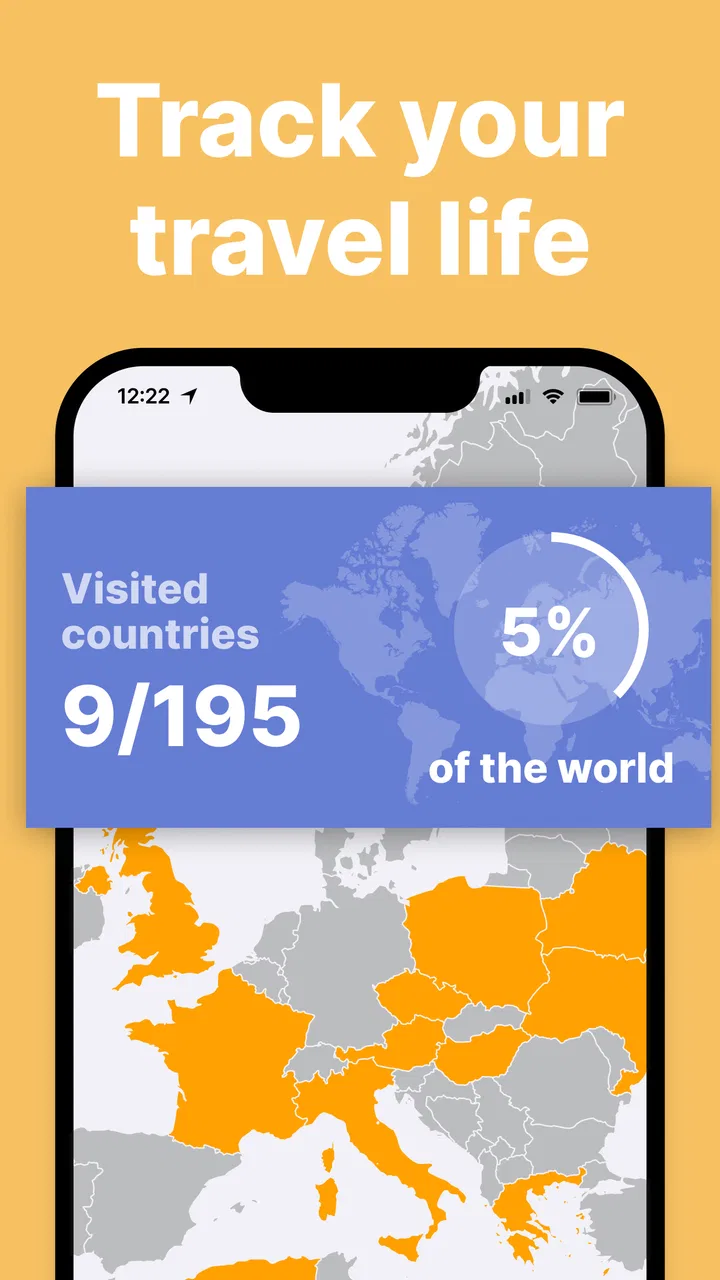
been: track visited countries
- 4.5
- Rating
- 1.00M
- Installs
- Free
- Price

 Analysis by App-foxy
Keeping track of the places I have visited sounds simple until the list starts growing. I have used notes, saved map pins, photo folders, and the occasional half-finished spreadsheet, but each method eventually became difficult to maintain. been takes a more focused approach: it is a travel and local app built around recording visited countries, creating a personal travel logbook, and keeping a checklist of places I still want to see.
That narrow purpose is its biggest appeal. This is not trying to replace a booking service, navigation tool, itinerary planner, or social travel network. Instead, it gives me a lightweight way to turn scattered memories into a visible record. The app is free to start, is suitable for everyone, and comes from Simple Apps You Love. Its current version is 2.8.3, and it runs on Android from OS 8.0 onward.
After spending time with it, I see been as a good fit for travelers who enjoy looking back at their journeys and gradually building a personal country checklist. It is less convincing for someone who needs detailed trip logistics, collaborative planning, or a full travel diary with extensive media and notes. The important question is whether a simple record of destinations is enough for you.
You May Also Like

 Blood Strike: 2.5 Anniversary
Blood Strike’s Loadouts Turn Every Drop Into a Tactical Gamble
A close look at Blood Strike’s custom loadouts: how fast access to signature weapons reshapes its battle royale rhythm, rewards preparation, and narrows the gap between fights.

 Pandora - Music & Podcasts
Pandora’s Music Is Easy to Start, but Harder to Recover
Pandora’s strength is its low-effort path from a seed to a station. Its weak spot is how much confidence it asks you to place in connection, setup, and quiet recovery.

 8 Ball Pool
 Is Built on Rivalries, Rematches, and Routine
A close look at the rivalries, rematches, shared routines, and unanswered safety questions that turn a quick pool match into a persistent mobile community.

 Samsung Music
’s Quiet Strength Is Playing What You Already Own
Its reach comes less from spectacle than from dependable access to a personal library. That simplicity is both the app’s strongest retention engine and its ceiling.

 AccuWeather: Weather Radar
AccuWeather Review: A Quick, Clear Forecast for Everyday Decisions
For everyday plans, the best forecast is the one you can understand quickly. AccuWeather makes rain timing, radar, and local conditions easy to act on, with a few trade-offs.

 Hill Climb Racing
Why Hill Climb Racing Still Turns Crashes Into One More Run
A tiny car, a bumpy hill and one more upgrade: Hill Climb Racing keeps resurfacing because its simple chaos makes every near-miss feel personal.
More From Our News Desk



How been feels in everyday use
I find been most useful when travel memories are shared at home but the record itself needs a clear owner. A family can use the country checklist as a conversation starter—where everyone has been and what they would like to visit next—while each person keeps their own notes and interpretation. That distinction matters, because a shared screen does not automatically make a shared archive or planning workspace.
A focused home for travel memories
The first thing I noticed is how clearly the app defines its job. Rather than surrounding the country list with unrelated travel tools, it encourages me to think in three connected ways: where I have been, what I remember, and where I would like to go next. That makes the experience easy to understand even if I only open it occasionally.
For a frequent traveler, the visited-country view can become a satisfying personal snapshot. It is not just a practical record; it also gives a sense of progress. A trip that once lived only in a camera roll or a boarding-pass email becomes part of a larger travel history. For a less frequent traveler, the same screen works as a gentle wish list rather than a demanding planning system.
I also like that the idea works for different travel styles. Someone who travels internationally for work can use it to avoid forgetting short visits. A family can use the checklist to discuss future holidays. A person who has recently started traveling can use it as a visual record of an evolving hobby. The app does not require every journey to become a detailed project.
Turning old trips into a useful record
The most useful setup is not necessarily to begin with your next trip. I would start by reconstructing previous journeys while the memories are still easy to place. Looking through photo albums, calendar entries, or old messages can help create a more complete baseline. This is a practical advantage over relying on memory alone, especially when several trips happened close together.
I would also separate “I passed through” from “I genuinely explored” in my own notes or personal system, if that distinction matters to me. A country checklist can make every visit look equal, even though an airport connection and a two-week road trip are very different experiences. That is not a flaw unique to been, but it is an important interpretation issue: the app can preserve the fact of a visit, while the meaning behind that visit remains mine to define.
For that reason, I find the logbook concept more valuable than the checklist by itself. A checklist answers where I have been. A logbook can remind me why the place mattered, what I did there, and which memories I want to revisit later. I would use short, consistent entries rather than trying to write a complete travel journal after every trip.
A realistic weekend workflow
Imagine returning home on Sunday evening after a short trip. I might first mark the country as visited, then add a brief note about the city, the reason for the trip, and one detail I do not want to forget. On Monday, I could add a second entry with a restaurant, museum, walk, or neighborhood that deserves a future return. Later, when planning another holiday, the checklist would show both completed destinations and possible ideas.
This workflow is deliberately modest. It does not ask me to organize receipts, compare hotel rates, calculate a route, or coordinate a group. That makes it realistic when I am tired after traveling. The trade-off is that I still need other tools for the practical parts of a vacation. been is best used as the memory layer, not the entire travel toolkit.
What the current version means for users
The app reached the market on February 20, 2024, and the current version indicates that it has continued to receive attention beyond its initial release. I would not treat a version number as proof that every personal request has been addressed, but it does make the app feel like an actively maintained product rather than a forgotten experiment.
That matters for a simple utility. A country tracker does not need constant visual change, but it does need dependable handling of saved information and a stable everyday experience. Existing users who already built a travel history should value continuity more than novelty. New users, meanwhile, can approach the current release as a mature starting point without expecting it to become a full booking or itinerary platform.
Its public reception is also encouraging: been holds a 4.5 average from around 6.1 thousand ratings, with more than 500 thousand installs. Those figures suggest that the straightforward concept connects with a substantial audience. They do not guarantee that every traveler will like the same design choices, so I would still judge it by the kind of record I want to keep.
Where it differs from familiar alternatives
The usual alternatives are surprisingly fragmented. A notes app offers flexibility but leaves me responsible for designing the structure. A spreadsheet can be precise, yet it feels like administration and is easy to abandon. A photo app preserves visual memories but may not provide a clean country-level overview. A map service is excellent for locations and routes, but it is not always the best place for a personal travel checklist.
been sits between those options. It is more purposeful than a blank note and less demanding than a spreadsheet. Compared with a map, it emphasizes the collection of countries and the story around them rather than navigation. Compared with a social travel platform, it feels more private and personal in spirit because the value comes from my own record, not from publishing a polished itinerary for other people.
That focus can also feel restrictive. If I want to track individual neighborhoods, exact attractions, transport legs, or a day-by-day route, a map or dedicated itinerary app will probably serve me better. If I want a richly illustrated diary, a notes tool with strong media support may be the better choice. I would choose been when the country-level overview is the center of the experience, not merely one small part of a much larger plan.
Small habits that make the app more useful
One helpful habit is to update the record soon after crossing a border or returning home, rather than waiting for the end of the year. Delayed updates create uncertainty, especially when several trips blend together. A quick entry while the details are fresh gives the logbook more personality and reduces the chance of leaving destinations unrecorded.
A second habit is to use the checklist as a planning filter instead of treating it as a race. I would group future destinations by realistic travel style in my own notes: places suited to a short break, places requiring more preparation, and places I want to visit only during a particular season. The app can hold the destination goal, while my surrounding notes preserve the reasoning behind it.
A third insight is that the app can help reveal patterns in my travel history. After recording enough trips, I might notice that I repeatedly visit capital cities, return to the same region, or choose destinations connected to food, architecture, family, or outdoor activities. That reflection is more valuable than simply counting countries. It can guide better future choices and prevent a checklist from becoming the only measure of travel.
Limitations I would consider before installing
The simple design is not ideal for everyone. Travelers who want extensive trip documentation may find a country-centered logbook too shallow. A long journey can include several regions, and a single country entry may not capture the differences between them. People who travel for work may also need dates, expenses, clients, and meeting details that are outside the app’s central purpose.
There is another subtle limitation: checklists can encourage quantity over depth. Seeing more countries marked as visited may feel rewarding, but it can also turn travel into a collection exercise. I would use the app as a memory aid, not as a scorecard. The best entries are likely to be the ones that help me remember an experience, not merely confirm that I crossed a boundary.
The free price makes experimenting easy, although in-app purchases range from $2.99 to $129.99 per item. That broad range means I would pay attention to what is included before committing to anything extra. For a casual user, the free experience may be enough to decide whether the concept fits. For someone building a long-term archive, it is sensible to understand the value of any optional purchase first rather than assuming every useful function is included at no cost.
I would also avoid treating the app as my only copy of important travel information. A personal logbook is valuable, but essential documents, reservations, and detailed itineraries belong in tools designed for those jobs. Keeping the app focused on memories and destination tracking makes the overall setup safer and more practical.
Who will enjoy it most
I would recommend been to people who want a clean, low-effort way to remember their international travel. It suits travelers who enjoy lists, visual progress, and looking back at where they have been. It can also be useful for families planning future destinations together, provided everyone understands that it is a personal tracking tool rather than a shared booking workspace.
It is particularly appealing if existing alternatives feel either too empty or too complicated. If a notes app never gives you enough structure, and a spreadsheet makes travel feel like paperwork, this focused format may be the comfortable middle ground. The app’s Everyone rating also makes its basic concept approachable for a broad audience.
I would skip it if my main goal is live navigation, price comparison, reservations, detailed route building, or collaborative itinerary management. I would also look elsewhere if I need a deeply customizable database with extensive fields and advanced sorting. been is strongest when I want to record and reflect, not when I need to operate an entire trip from one screen.
What I would watch as the product develops
For future updates, I would be most interested in how the app balances simplicity with deeper personal history. More detail can make a logbook richer, but too many controls could undermine the quick-entry experience that makes a focused tracker attractive. The best evolution would preserve the fast country overview while making meaningful memories easier to organize.
I would also watch how existing records are treated as the app changes. Long-term users need confidence that their carefully assembled travel history remains easy to understand and maintain. Improvements are most useful when they reduce friction for people who already have years of destinations to enter, not only when they add something flashy for new installations.
Another area worth watching is the relationship between the visited list and the future checklist. The two sides should feel connected without turning the app into a competitive travel counter. A thoughtful balance could help users plan with more intention: not just asking which country comes next, but understanding what kind of experience they actually want.
My recommendation
After using it as a focused travel record, I see been as a pleasant companion for anyone who wants their country history in one dedicated place. The developer, Simple Apps You Love, has chosen a clear idea instead of trying to cover every travel task, and that restraint is the reason the app is easy to approach.
My recommendation comes with a clear condition: use it alongside your normal travel tools, not instead of them. Let a booking app handle reservations, a map handle directions, and a notes or photo app preserve detail when needed. Use been to connect those experiences into a simple personal record that you can revisit later.
For me, the strongest reason to keep it installed is not the satisfaction of filling another checklist. It is the chance to remember the shape of my travels without maintaining a complicated archive. If that sounds useful, the free starting point makes it easy to try. If you need a complete travel command center, this focused app will feel limited, but that limitation is also what gives it its character.
FAQs for been: track visited countries
01How does the app track the countries I've visited?
The app uses your device’s GPS and location services to accurately track your visits to different countries. Once you enter a new country, the app records your location and updates your travel log automatically. You can also manually add locations if you prefer to disable GPS tracking.
02Is my location data safe with this app?
Yes, your privacy is a top priority. The app encrypts your location data and only stores it locally on your device or securely in the cloud, depending on your settings. You have full control over your data and can choose to delete it at any time.
03Can I view my travel history offline?
Absolutely! The app allows you to access your travel history without an internet connection. This feature is especially useful when you're traveling in remote areas with limited connectivity. All your past trips and visited countries are stored locally and can be viewed offline.
04Does the app offer any additional features besides tracking?
Yes, the app includes several additional features such as travel statistics, a digital journal, and the ability to share your travel milestones on social media. You can also connect with other travelers, exchange tips, and get recommendations for your next destination.
05What platforms is the app available on?
The app is available for both Android and iOS devices. You can download it from the Google Play Store for Android or the App Store for iOS. It is optimized for smartphones and tablets, ensuring a seamless user experience across different devices.
Pros
- Intuitive interface for easy navigation.
- Offline maps to save data usage.
- Personalized travel statistics.
- Integration with social media platforms.
- Customizable country lists and categories.
Cons
- Limited free features
- requires in-app purchases.
- Occasional location inaccuracies.
- No support for older OS versions.
- Limited language options available.
- Requires frequent updates for new features.

been: track visited countries
Gallery